
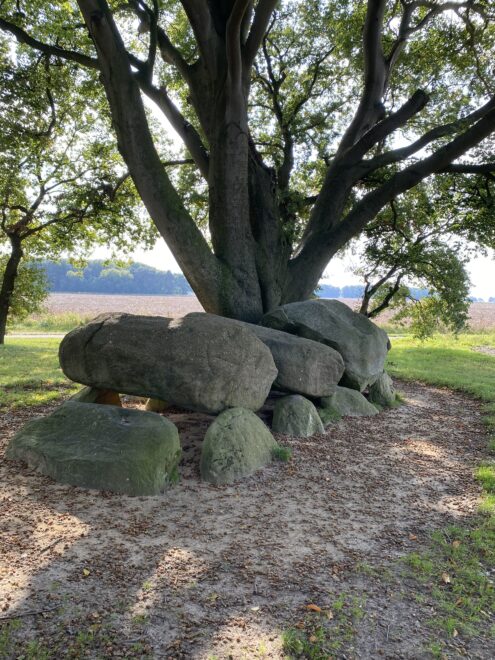
Did you know what a Hunebed is? There are a good number of these in the province of Drenthe, in the north of the Netherlands. These structures made of large boulders are megalithic tombs from 3400 to 2800 BC. They are the equivalent of Dolmen in the UK and Ireland.
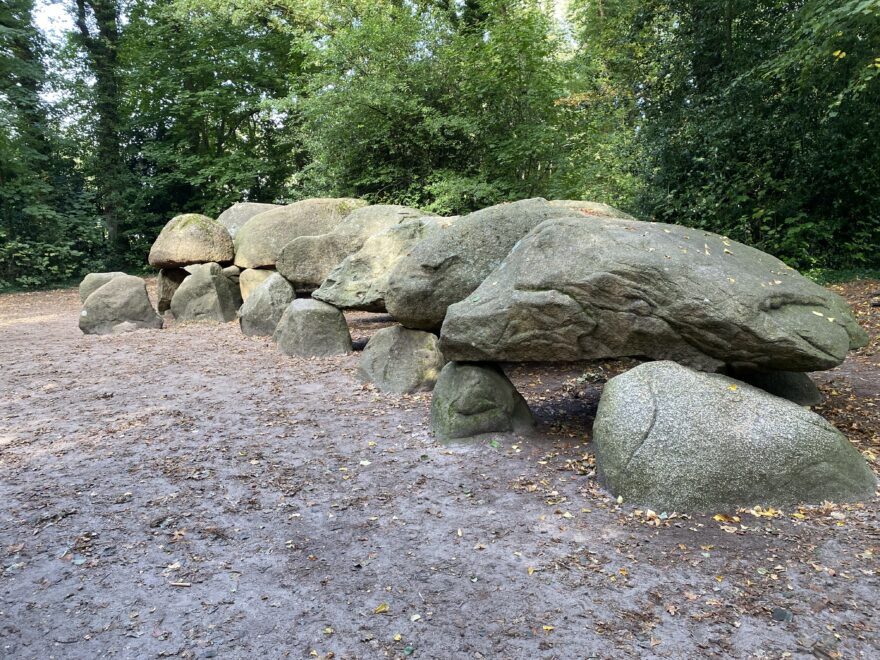
The largest hunebed in the village of Borger
The large, heavy boulders are remnants of the last Ice Age, when most of the Netherlands was covered in ice. The boulders were transported under the ice-flow, and many have been traced back to different parts of Scandinavia.
Apparently, the stones were covered with earth so that they formed underground chambers that were not just used for burial, but also for community activities and religious rituals.
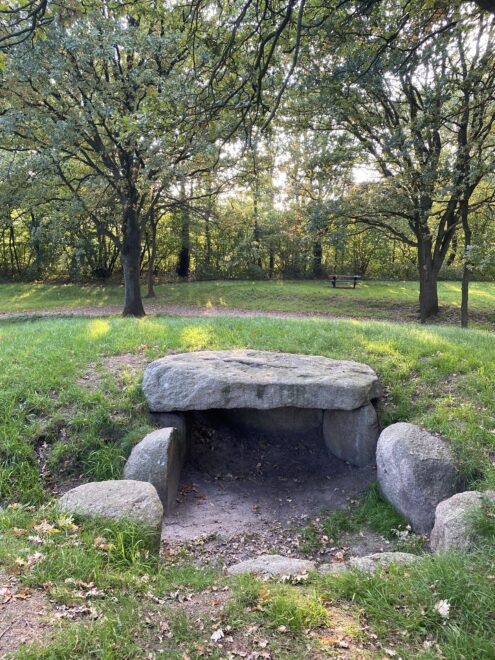
Many have disappeared over the centuries, when farmers and local people used the stones for other purposes but a significant number remain, with 52 still visible in Drenthe. They are all located on a narrow low sand ridge N-S in the middle of the province, called de Hondsrug, as the east and west of the region used to be swampy land in pre-history and until the Middle Ages.
During the last but one ice age, some 150,000 years ago, the surface of the Northern Netherlands was shaped by a river of ice, flowing from the northwest to the southeast, resulting in the straight parallel ridges of the Hondsrug complex. The area is so unusual that it is now a UNESCO Geopark.
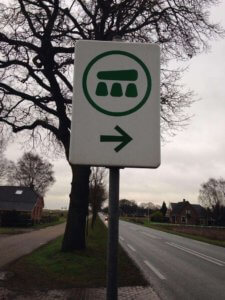
The Dutch dolmen are now historical monuments that can be visited by the public as part of a pre-history tourism trip. The locations are indicated with small direction signs, and have information panels available at each site. These are specifically made for bicycle visitors, as many of the dolmen are located in fields off the main roads, and there are bicycle trails throughout the province.
The Hunebed Centre in the village of Borger offers more information about the culture and history surrounding these amazing structures. It has a museum with the discoveries from the various archeological digs, videos and educational panels. There is a garden with boulders from different parts of northern Europe, and an open air exhibition of what houses and tombs will have looked like in the prehistoric times.
A great day for tourists from all over the world, who want to learn more about these amazing monuments that are such special places in the landscape.

0 comments
Write a comment