
Last week, I had a meeting with the European secretariat of ICLEI – Local Governments for Sustainability in Freiburg, Germany (http://www.iclei-europe.org/) after a comfortable train ride from Gland, Switzerland, where the IUCN Europe office is located. ICLEI is an international NGO Member of IUCN, based in Europe, and we talked about the challenges for local authorities in dealing with biodiversity, and discussed possible areas for collaboration.
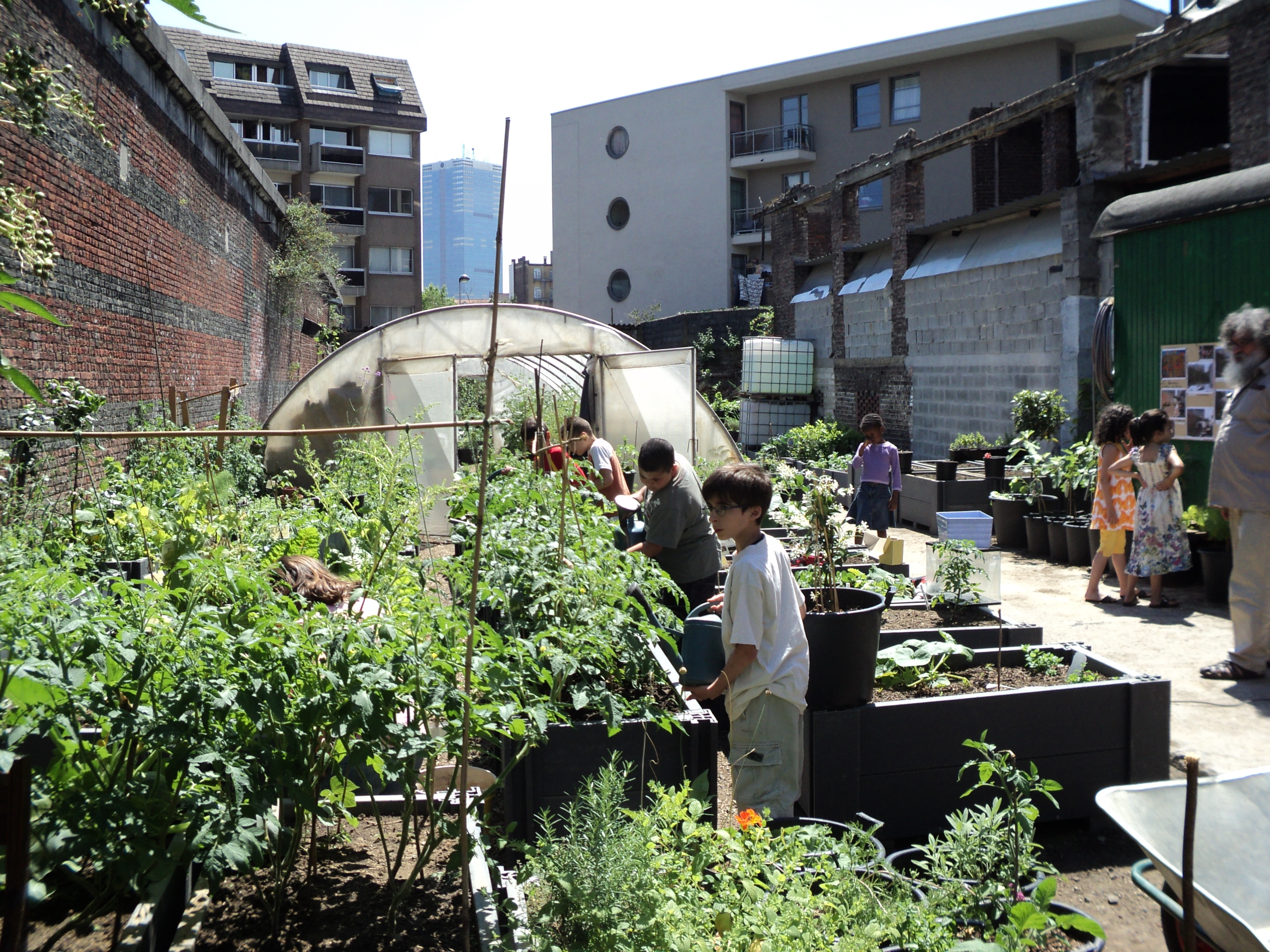
Cities and regional authorities have direct responsibility for the management of natural resources, such as land, water and forests, but they typically have not considered how to deal with biodiversity and ecosystems. Most cities have staff dealing with parks and green spaces, and water quality of local stream and lakes. Many are also actively involved in curbing greenhouse gas emissions, and promoting alternative energy and more sustainable transport options. Yet, few cities have a biodiversity officer or city ecologist, and many have not yet worked out what the value is of the ecosystem services provided by nature in and around the city. The photo below shows urban agriculture in Brussels, by www.eco-innovation.net;
IUCN and the Swiss Federal Agency for Environment are organising a side event during the next Conference of Parties of the Convention on Biological diversity (CBD COP11) in Hyderabad, India in October this year, to present lessons learned from several European cities. These examples are individual case studies, and we hope that by making their experiences public, other cities will follow their lead.
Significantly, the last Conference of Parties of the Convention on Biological Diversity (CBD COP10) in Nagoya, Japan, adopted on 29 October 2010 a Plan of Action on Sub-national Governments, Cities, and other Local Authorities for Biodiversity. As a result, there is now a political pressure for mayors to come up with biodiversity strategies and action plans for their cities, but we believe that many city governments are struggling.
IUCN Europe and ICLEI Europe are already partners in a large, EC-funded trans-disciplinary collaboration project between nine top European research institutes called Urbes (http://urbesproject.org). Urbes aims at bridging the knowledge gap on urbanization processes and urban ecosystem services, as underpinned by biodiversity. In our meeting last week, we discussed how we can be more strategic and come up with a joint programme of action to help cities and local authorities in Europe with biodiversity and ecosystem management.
I will keep you posted on the progress in the months to come – a lot will depend on finding financial resources to make things happen! Any suggestions?

These are excellent perspectives, congratulations to IUCN Europe. I’m convinced that promoting sub-national implementation of the UN Strategic Plan on Biodiversity 2011-2020 and all of its targets and programmes of work (i.e. strengthening cooperation between all levels of government, and involving regions, States, municipalities, towns and all sorts of local authorities in managing biodiversity and related ecosystem services) will generate the best return for any donor today, i.e. the best bang for the buck in real biodiversity and development gains. We need to build up IUCN’s capacity to make even more positive interventions in this field. I hope that the WCC in Jeju and CBD COP 11 in Hyderabad will allow IUCN and its partners, like ICLEI, to engage in activities and programmes to apply, in a practical and scaled up approach, the lessons learned through Urbes, other academic networks like URBIO and the soon-to-be-launched Cities and Biodivesrity Outlook.
Thank you Oliver. We are looking forwards to working with the Secretariat of the Convention on Biological Diversity to make this happen.
Best regards
Hans